How the Information Ecosystem Holds Back Progress
The media rewards fear. Builders need to tell better stories.

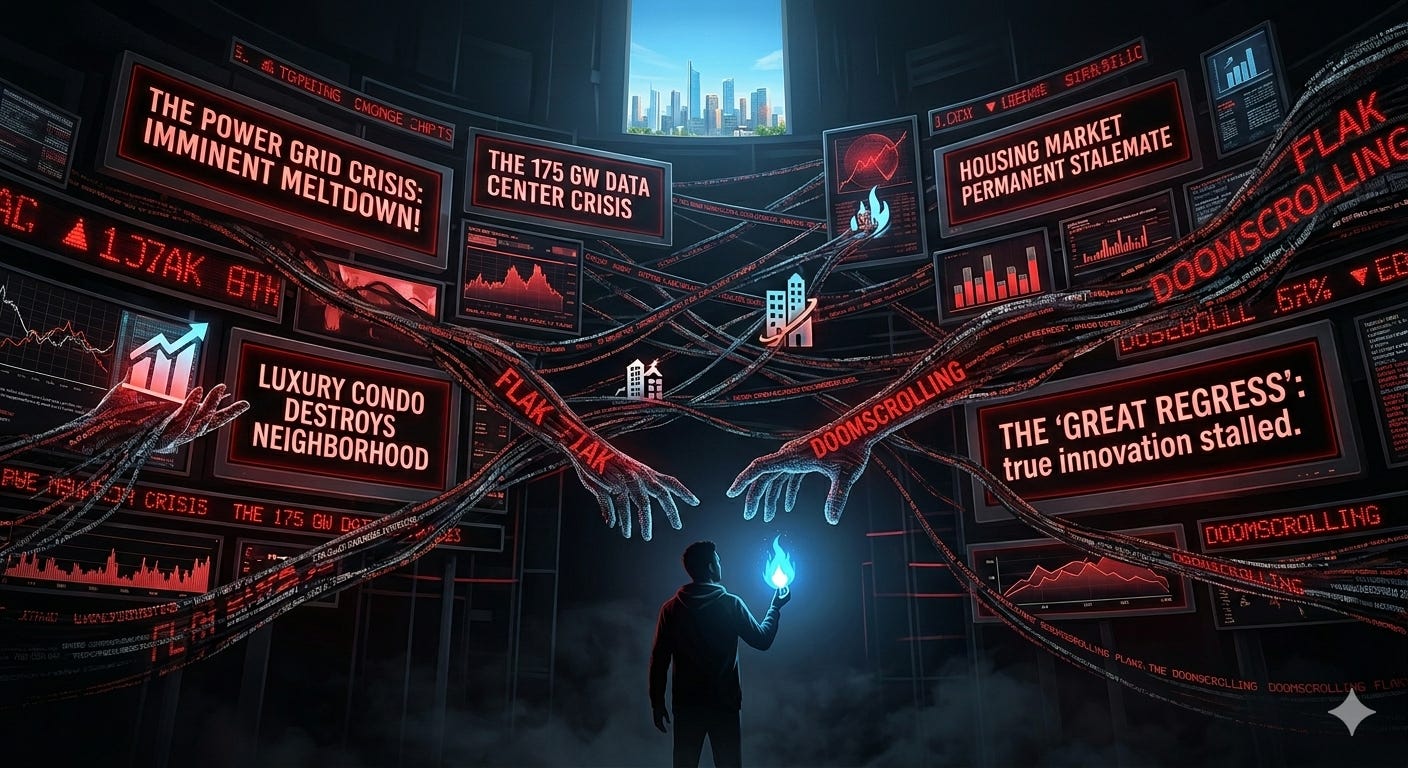
“If you don’t read the news, you’re uninformed; however, if you read the news, you are misinformed,” goes the common saying. Which is worse? It comes down to confidence. Overwhelming confidence in the (mis)information gained from reading an article or watching a video may be just as dangerous (or even more) than not having that knowledge at all. What can be worse than that is confidence in misinformation laced with morality, effectively reducing one’s IQ.
This collection of misinformation is a narrative built from bundled asymmetries, ranging from visible harms over invisible benefits to concentrated losses over diffuse gains to emotional storytelling over systems-level tradeoffs and procedural conflict over long-term outcomes. These narratives further the tyranny of the complainers, who rail against costs while systematically downplaying any benefits.

Narrative matters enormously for Abundance and Progress politics because almost every project has concentrated local costs, delayed distributed benefits, technical complexity, uncertain attribution, and low emotional salience. Our information environment systematically rewards anti-building politics and institutional paralysis.
This pattern is not accidental but is the predictable result of a system that rewards certain narratives and punishes others. To see why this happens, we need to follow the information ecosystem from the old gatekeepers, when news was shaped under conditions of information scarcity, to the internet, which broke the old monopoly over information but replaced it with new pressures: subscriptions, viral outrage, and constant flak. The essay closes by turning to how builders, abundance advocates, and progress-minded folk can work within this environment, reach persuadable audiences, and make the benefits of abundance feel as real as the costs.
Chomsky and the News Cycle
You may ask yourself why news outlets create misinformation and asymmetrical attention to detail. Why do they put their fingers on the scale? Shouldn’t they strive to be honest and true? The truth doesn’t always sell, and in a world where the prime economy is your attention, ruthlessness pays. Yet, it is deeper than just the money. In their 1988 book, Manufacturing Consent, Noam Chomsky and Edward S. Herman argue that mass media in liberal democracies function less as an independent watchdog and more as a system that subtly manufactures public agreement with elite political and economic interests.
This is not 1984; journalists are not centrally controlled. Thoughtcrime won’t get you thrown in jail (but it might get you doxxed or sent to BlueSky purgatory). The propaganda model by which news is shaped and molded before getting to readers is structural. Such pressures shape and filter what becomes news, how that news is framed, and which viewpoints are treated as legitimate before it reaches the reader.
Herman and Chomsky identify five main filters:
Ownership: Major media organizations are profit-seeking institutions dependent on investors and market stability; they tend to avoid content that fundamentally threatens elite economic structures.
Advertising: Traditional commercial media relies heavily on advertisers for revenue, and are incentivized to attract audiences while avoiding material that could alienate sponsors.
Sourcing: News organizations depend on governments, corporations, institutions, and official experts for a steady flow of information. As a result, official narratives dominate coverage.
Flak: Much content is designed to reduce flak, the organized negative responses to media content, including complaints, lawsuits, pressure campaigns, lobbying, or political attacks.
Ideology: Powerful actors can punish outlets that stray too far from acceptable narratives, encouraging self-censorship.
All of these combined pushed elite and government views onto the populace, especially pro-American government, anti-communist views, which the authors claim were the central ideological filter during the Cold War. The filters, enabled by the legacy media, divided acceptable and unacceptable opinions.
After the Cold War, many analysts adapted this filter to concepts such as nationalism and market fundamentalism. Chomsky even added material in the second edition claiming the “War on Terror” had replaced “anti-communism” as the ideological filter. However, Chomsky only assumed that the apparatuses used to filter news would operate against his views; he did not consider that news could be filtered to fit a variety of narratives, alternative facts, or cater to a specific ideology.
Internet Destabilized Traditional Media
Chomsky and Herman assumed the filters would remain largely centralized and elite-driven, but they did not foresee the Internet age, not even in the early-2000s second edition.1 Governments, media organizations, universities, corporations, and political parties were built for an age of information scarcity, when elites controlled the flow of knowledge. The internet destroyed that monopoly. Ordinary people now have access to massive amounts of information and can publicly criticize institutions in real time. As a result, institutions increasingly struggle to maintain their legitimacy (as outlined in Martin Gurri’s The Revolt of the Public).
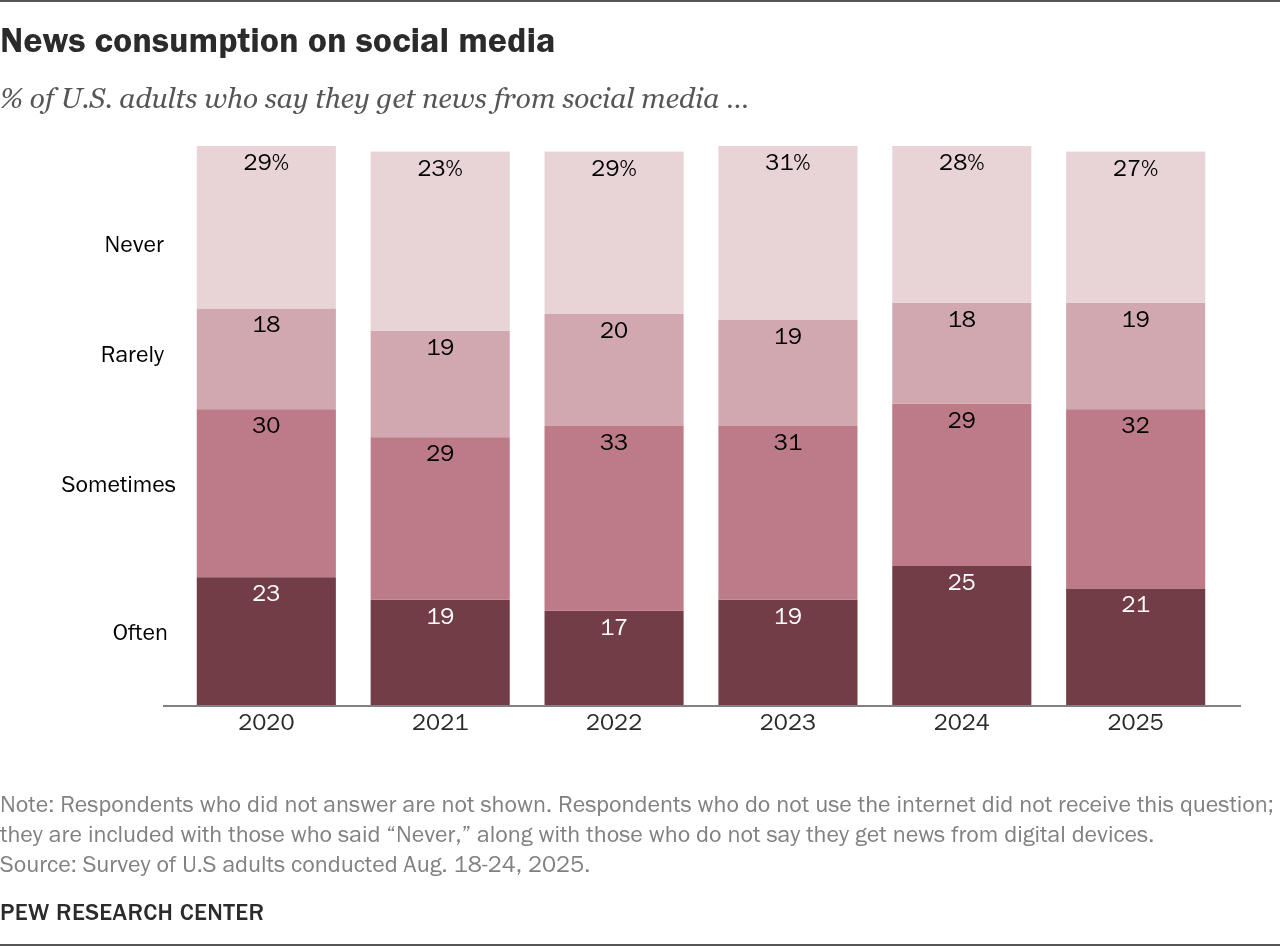
The internet transformed flak from episodic institutional pressure into continuous distributed pressure. Chomsky could not have foreseen that corporations would cave to activist demands so readily. Flak is not just some lawsuit; it comes in the form of an angry mob of terminally online people who will roast you on Twitter. The angry mob has opinions, and they will seek to consume media that aligns with those opinions. Someone will cater to them because their attention is followed by clicks, ad revenue, and maybe even a paid subscription.
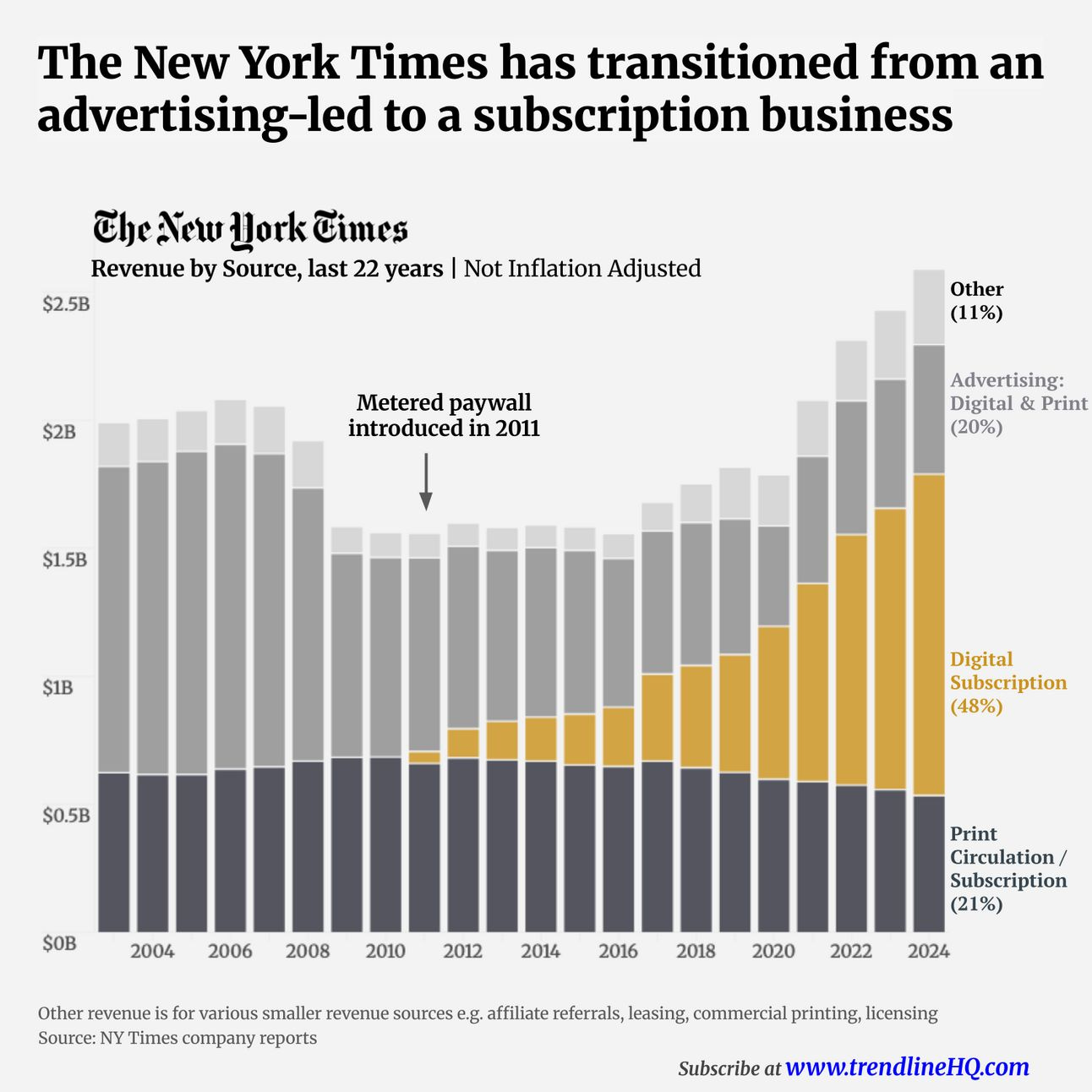
Subscribership then became a sixth filter, one that Chomsky did not see. In 1988, subscription models for media were mostly based in smaller productions. As the internet democratized information flows, people had greater choice in their media consumption. In the early 2010s, the NYT changed its revenue model. No more would it receive the majority of its revenue from ads; instead, it paywalled its website and began requiring subscriptions to read digital content. All of a sudden, the mass media giant needed to tailor its message and tone to maintain its readership. Where advertising-era media optimized for mass audiences, subscription-era media optimizes for retention and audience alignment.
Tailored news feeds via subscriptions offer readers customized information flows and can reduce the costs of searching for articles, podcasts, and news relevant to their interests. However, this has downsides. It has made the infosphere a more fractured and polarized place. When there were only a few major news sources, with each having its own opinion, one could rightly guess the truth was somewhere in the middle. A decentralized system weighted by and filled with panderers makes the truth harder to determine.
In the subscription world, if you hear something you disagree with, you don’t have to change your mind, just change your media diet.
The Problem Persists with Decentralized News Feeds
Now that legacy media has been increasingly displaced by the internet, why does every infrastructure story still end up being about displacement, environmental justice, procedural conflict, corruption, local harms, and identity conflict? Projects could instead become state capacity, abundance, productivity, future growth, lower cost of living, and scientific advancement? Because conflict narratives outperform developmental narratives in the attention economy. Whether it is hating on data centers, paleoconservatism, or degrowth in the name of environmentalism and climate change, negativity has a hold on the information being spread across reels, shorts, newsletters, tweets, and headlines.
On top of that, fear sells and can be delivered at the speed of a TikTok video. Fearmongering of one kind or another drives so much viewership. Fear of building pervades newspapers and feeds everywhere. How dare they build this? Look at who it harms! Inequality! Justice! (Even if building would reduce inequality and empower underprivileged communities.) News outlets and feeds are still choosing the worthy and the unworthy: Who you can root for. Who you can feel sorry for. Who you must be angry towards. It’s called doomscrolling, not funscrolling.
Fear and worry lead to negative social contagion, causing people to lash out at items in their feeds, not because there is anything substantive behind their claims, but because of unknowns. Expressing anger and hate towards the unknown will earn them fake internet points and reward their dopamine centers. This, at the macroscale, constitutes the part of the information ecosystem that is anti-growth and opposed to dynamism.
The environment selects for stories that trigger moral emotion, create identifiable victims, personalize blame, and simplify causality.“New housing lowers aggregate rents over time” is weak content, but “Luxury condo destroys neighborhood character” is strong. Outlets and creators select a variety of aspects disseminated through their stories; some facts are hyper-amplified, while others are ignored. Proportions become distorted, tradeoffs disappear, and downstream effects are omitted. The asymmetries are still present, but it doesn’t have to be that way.
The Path Forward
A civilization capable of building requires institutions that can tolerate tradeoffs, think long-term, reward builders, contextualize risk, and distinguish local harms from civilizational gains. Our current information ecosystem struggles to do that. Progress and Abundance operate in an environment that fears and resists resolving uncertainty.
Hope is not lost. Abundance and Progress folks can overcome these challenges and influence information flows at large. This can be done at both the macro- and microscales.
A missing piece of many projects, ranging from housing projects to data centers, is public engagement and community outreach. People care about what is going on in their communities, and many of them will be uninformed. Their questions can be grating if you are in the policy space or a builder because the benefits are obvious to you. However, the majority of the public have concerns that come from a desire to have their fears alleviated and their questions answered; the concerns come from a place of caring. It is up to you to meet them where they are at and answer their questions and concerns in good faith.
One such avenue is public meetings. Locals show up and ask questions. If their concerns are taken seriously and questions are answered, whether or not they agree with the project moving forward, they will leave the meeting feeling heard. You want to give them that information because if they are not taken seriously or their questions are dismissed, they will seek it elsewhere. The sources they find online may not extol the virtues of the project but may instead radicalize them against it.
Some people show up to meetings and post online, having no intention of proceeding in good faith. Recognize the bad actors. When they say something untrue or outrageous, provide a counterpoint, but avoid arguing with those acting in bad faith. The reasons for this are twofold:1) You will never beat irrationality with rationality, and 2) They are not your target audience. The people you want to reach are the marginal consumers, the swing voters, the people whose minds can be changed or fears can be alleviated.
Speak to people and write for people outside of Abundance and Progress circles so that you don’t accidentally create an echo chamber. Your target audience is, at some level, the marginal consumer, even when you are explicitly writing for your dedicated audience. Tech companies recently failed to prioritize marginal consumers and are now suffering the consequences, which is surprising because in many other domains, tech companies excel at marketing to the marginal consumer.

Change the narrative by emphasizing the benefits and avoiding complaints unless you immediately follow them with a solution. Try to make the benefits real and concrete. The stories people tell themselves form the basis of how they understand the world. The information ecosystem is already stacked against the hopeful future you are offering; negative bias causes people to focus on the bad rather than the good, even when the benefits outweigh the costs. So, you will need to continually and fervently inject hope into the narrative. The benefits can tell an emotionally riveting story; inject some ethos along with the pathos. At the same time, you will need to acknowledge the costs directly, otherwise people will assume you are proselytizing. In a way, you are: you represent the future that could be, but remember, you need to meet people where they are at.
Avoid squabbling2 with your fellow Abundance and Progress folk in public, as it can attract negative-sum attention: when two people who are supposed to be aligned fight in public, it diminishes the status of all parties involved. Spats do not advance the cause; they feed into the negative information ecosystem.
Lastly, engage with your neighbors and communities in ways that do not include taking up the mantle of your politics. Volunteer in local clean-ups. Have dinner parties and get-togethers. Coach a youth league sports team, even if you don’t have kids. Small things like this provide lasting value, increase social trust, and make the world around you a better place.
It is up to you to shine, to increase the light. The hyperreactivity, negativity, and fearmongering of modern media are a kind of valley of the shadow of death. Just because the news and the social media cycles reward negativity and veto politics, it doesn’t mean that we must succumb to their machinations. Abundance and Progress can overcome them.
Special thanks to Abby ShalekBriski, Ariel Patton, and Tina Marsh Dalton who all gave helpful feedback on earlier versions of this post.
Chomsky and Herman did talk about the Internet and its effect on media in a 2009 interview: https://www.westminsterpapers.org/article/id/127/
This does not mean one cannot or should not disagree with their fellows, only that the venue and content matter. Discourse over responsive essays is much more conducive to solidarity than arguments on Twitter. Maximize positivity, as negativity will only degrade your position.